On this page
- What Are Food Delivery Marketplaces, Really?
- The Hidden Costs of Marketplace Dependency
- What a Restaurant Online Ordering System Looks Like in 2026
- Why WordPress Restaurant Owners Have a Serious Advantage
- Head-to-Head: Marketplace vs. Your Own Ordering System
- “But I Need the Marketplace Traffic…”
- The Real Cost Comparison Over 12 Months
- What About Delivery?
- Building Customer Loyalty Without a Middleman
- SEO Benefits of Direct Ordering
- Getting Started Without the Overwhelm
- Final Thoughts
Running a restaurant in 2026 means dealing with one unavoidable truth: your customers expect to order online. The real question isn’t whether you need an online presence — it’s how you build it.
Most restaurant owners face two paths. You either list your business on a food delivery marketplace like Uber Eats or DoorDash, or you set up your own restaurant online ordering system directly on your website.
Both options put food in front of hungry customers. But they’re wildly different in terms of cost, control, and long-term value. Let’s break it down honestly so you can make the right call for your business.
—
What Are Food Delivery Marketplaces, Really?
You know the names — Uber Eats, DoorDash, Grubhub, Just Eat. These platforms act as middlemen between your kitchen and your customers.
Here’s what they offer:
– Instant access to a large customer base already browsing for food
– Built-in delivery logistics so you don’t need your own drivers
– Marketing exposure without running your own ads
Sounds great on paper. And for brand-new restaurants with zero online presence, marketplaces can generate early traction.
But there’s a catch. Several, actually.
—
The Hidden Costs of Marketplace Dependency
Let’s talk numbers, because this is where things get uncomfortable.
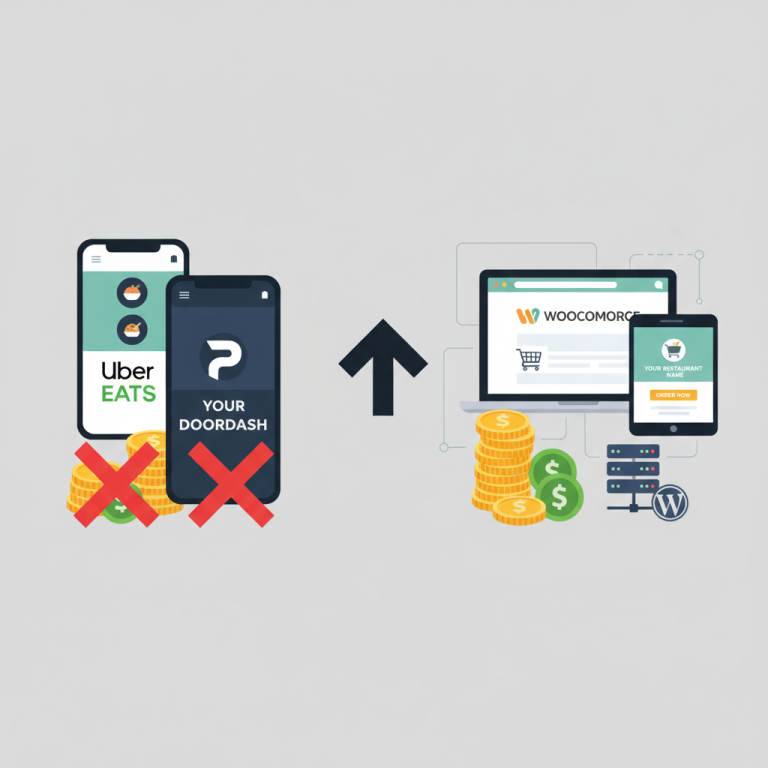
Most delivery marketplaces charge commissions between 15% and 35% per order. On a $40 order, you could be handing over $14 before accounting for food costs, labor, or rent.
Here’s what else you’re giving up:
– Customer data. The marketplace owns it, not you. You can’t build an email list, run retargeting ads, or even know who your regulars are.
– Brand identity. Your restaurant sits next to dozens of competitors. Customers develop loyalty to the app, not to you.
– Menu control. Platforms often dictate how your menu looks, and some even pressure you into discounts or promotions that eat into your margins.
– Pricing flexibility. Many restaurants inflate menu prices on marketplaces just to break even — which frustrates customers who notice the difference.
I’ve talked to restaurant owners who describe marketplace dependency as “renting someone else’s audience at premium prices.” That’s a pretty accurate summary.
—
What a Restaurant Online Ordering System Looks Like in 2026
The alternative is owning your ordering channel. You install a system on your own website, and customers order directly from you.
No middlemen. No commission fees. No competing with the restaurant down the street on the same screen.
A solid restaurant online ordering system gives you:
– Full ownership of customer relationships — emails, phone numbers, order history
– Complete brand control — your colors, your layout, your story
– Higher profit margins — you keep what you earn
– Menu flexibility — update items, prices, and specials in real time
– Integration with your existing tools — POS systems, payment gateways, delivery management
The technology has matured dramatically. You don’t need a development team or a massive budget. If your restaurant runs on WordPress (and millions do), you can have a professional ordering system up and running in a day.
—
Why WordPress Restaurant Owners Have a Serious Advantage
WordPress powers over 40% of the web. If your restaurant website is built on it, you’re already sitting on a flexible, powerful platform.
The missing piece? A plugin that turns your site into a fully functional ordering machine.
That’s exactly what FoodMaster — a restaurant ordering system built for WordPress — does. It’s designed specifically for restaurant owners who want to take orders directly through their own website without the marketplace tax.
Here’s what makes FoodMaster worth a serious look:
– WooCommerce integration — leverages the world’s most popular ecommerce framework
– Customizable menus with add-ons, variations, and extras
– Delivery and pickup options with zone-based configuration
– Tipping functionality built right into the checkout
– Order management dashboard so your kitchen stays organized
– Mobile-friendly design because most of your customers are ordering from their phones
Setting it up doesn’t require coding knowledge. If you can manage a WordPress site, you can run FoodMaster.
—
Head-to-Head: Marketplace vs. Your Own Ordering System
Let’s compare the two approaches side by side.
| Factor | Marketplace | Own Ordering System |
|—|—|—|
| Commission fees | 15–35% per order | None (one-time plugin cost) |
| Customer data | Owned by platform | Owned by you |
| Brand visibility | Competing with others | 100% your brand |
| Menu control | Limited | Full control |
| Profit margins | Lower | Higher |
| Setup effort | Minimal | Moderate (but straightforward) |
| Long-term value | Low — you’re building their brand | High — you’re building yours |
The marketplace wins on one thing: convenience at the start. Everything else favors owning your system.
—
“But I Need the Marketplace Traffic…”
This is the most common objection I hear, and it’s valid. Marketplaces do bring eyeballs.
Here’s the thing though — you don’t have to choose one exclusively.
A smart strategy for 2026 looks like this:
1. Use marketplaces as a discovery channel. Let new customers find you there.
2. Drive those customers to your own website for repeat orders. Include a flyer in every marketplace delivery bag with a discount code for ordering directly.
3. Build your direct ordering channel as your primary revenue stream. Over time, shift the balance so you’re keeping more of every dollar.
Think of marketplaces as rented advertising. Your own food ordering system is the asset you actually own.
—
The Real Cost Comparison Over 12 Months
Let’s do some quick math with realistic numbers.
Scenario: A restaurant doing 50 online orders per day with an average order value of $35.
Marketplace route (25% commission):
– Daily commission: $437.50
– Monthly: ~$13,125
– Annual: $157,500 in fees
Direct ordering with FoodMaster:
– Plugin cost: One-time purchase (a fraction of one day’s marketplace fees)
– Payment processing: ~2.9% + $0.30 per transaction (standard)
– Annual processing fees: ~$19,000
– Annual savings vs. marketplace: roughly $138,000
That’s not a rounding error. That’s a full-time salary. Or a kitchen renovation. Or a marketing budget that actually builds your brand.
—
What About Delivery?
One legitimate advantage of marketplaces is their delivery fleet. If you don’t have drivers, that matters.
But the landscape has shifted. In 2026, you have options:
– Hire your own delivery staff — you control the experience
– Use third-party delivery-only services like Nash or Cartwheel that handle logistics without taking a cut of your food sales
– Offer pickup options — many customers prefer it, and it costs you nothing extra
With FoodMaster, you can configure delivery zones, set minimum order amounts, and manage both delivery and pickup from the same dashboard. The flexibility is built in.
—
Building Customer Loyalty Without a Middleman
Here’s something marketplace advocates rarely mention: you can’t build real customer loyalty on a rented platform.
When someone orders through Uber Eats, they open Uber Eats next time — not your website. Their loyalty belongs to the app.
When someone orders through your site, you can:
– Send personalized email offers based on past orders
– Create a loyalty program that rewards repeat customers
– Run seasonal promotions on your own terms
– Collect reviews and testimonials for your brand, not a third-party platform
– Retarget visitors with ads that bring them back
This is how you turn one-time buyers into regulars. And regulars are where the real money is in the restaurant business. Always has been.
—
SEO Benefits of Direct Ordering
Here’s a bonus many restaurant owners overlook. When customers order through your website, they spend more time on your site. They browse your menu. They read your story. They check your hours and location.
All of that activity sends positive signals to Google. Your site climbs in local search rankings. More people find you organically. More organic traffic means more orders without paying for ads or marketplace commissions.
A restaurant online ordering system on your own domain is literally an SEO engine that pays for itself.
—
Getting Started Without the Overwhelm
If you’re currently relying entirely on marketplaces, the switch doesn’t need to happen overnight. Here’s a practical roadmap:
Week 1: Install FoodMaster on your WordPress site. Set up your menu, delivery zones, and payment gateway.
Week 2: Test the system with staff orders. Iron out any kinks in the workflow.
Week 3: Soft launch with your existing customer base. Email list, social media, in-store signage.
Week 4: Start including direct-order incentives in every marketplace delivery. A simple card that says “Order direct and save 10%” works wonders.
Months 2–6: Gradually shift your marketing spend toward driving traffic to your own site. Track the numbers. Watch your margins improve.
—
Final Thoughts
Food delivery marketplaces aren’t evil. They serve a purpose, especially for visibility. But building your entire online ordering strategy on a platform that takes a quarter of your revenue and owns your customer relationships? That’s not a long-term plan. That’s a trap dressed up as convenience.
In 2026, the tools to run your own restaurant online ordering system are affordable, powerful, and accessible — even if you’re not tech-savvy. WordPress plugins like FoodMaster have leveled the playing field, giving independent restaurants the same capabilities that used to require custom-built software.
Own your orders. Own your customers. Own your margins.
That’s the move.
Commission-free ordering
Run restaurant orders on your own WordPress site
FoodMaster adds delivery, pickup, dine-in, POS, and kitchen tools — with zero per-order fees.